
Guides, Pelican Auto Care at 31465
Car battery life in Florida heat
Everyone blames the cold. In this state it is the heat that does the damage, and the cold morning only delivers the news.
The short answer
How long does a car battery last in Florida heat?
Less time than the same battery would manage in a cool climate, which is the part most people have backward. Heat is what does the damage: sustained high under-hood temperatures accelerate the chemical reactions and the internal corrosion that use a battery up. Cold weather does not cause the failure, it reveals it, because a cold engine is harder to turn and a battery already weakened by summer finally cannot manage it. The practical consequence is that a battery here is worth testing, not trusting, once it has a few years on it, since modern batteries often go from apparently fine to unable to start the car with very little warning. A slow crank is the most useful symptom, but it is not guaranteed to arrive first.
Heat does the damage, cold sends the bill
A lead acid battery works by a chemical reaction, and chemical reactions run faster when they are hot. That sounds like an advantage and is not. The faster everything runs, the faster the plates corrode, the faster the internal grid degrades and the faster water evaporates out of the electrolyte. Heat is what consumes a battery's working life.
Cold does something different. It thickens the engine oil so the starter has more to turn, and at the same time it slows the reaction inside the battery so less current is available. A battery that heat has already weakened will usually get through a Florida summer and then fail on the first genuinely cool morning, which is why the cold takes the blame for damage the heat did.
Under a hood in a Florida summer, in traffic, the temperatures involved are well above the ambient air. That is the environment the battery lives in, all day, for months at a time.
What else shortens the life
Short trips are the quiet one. Starting an engine takes a substantial amount of charge and the alternator needs running time to put it back. A pattern of five minute journeys never replaces what each start took, so the battery spends its life partially discharged, which accelerates the sulphation that eventually makes it unable to hold a charge at all.
Vibration is the second. A battery that is not clamped down properly shakes its own internal structure apart over time, and a loose hold down is a genuinely common finding.
Then there is what the car does while parked. Alarms, keyless entry receivers, trackers and control modules all draw a small current continuously. That is normal and designed for, but a vehicle that sits for weeks, or one with a fault causing more draw than it should have, can flatten a healthy battery on its own.
Signs worth paying attention to
The clearest is cranking that has slowed. If the engine turns over more lazily than it used to, particularly first thing, that is the battery telling you it is nearing the end. Headlights that dim noticeably while cranking say the same thing.
A battery warning light is not simply a battery light. On most vehicles it indicates a charging system fault, which means the alternator or its circuit as often as the battery itself, and it should not be ignored on the assumption that a new battery will settle it.
Physical signs are worth a look while the hood is open: white or blue powder around the terminals, a case that has swollen or bulged, or a smell of sulfur. A swollen case in particular means the battery has been cooked, and it should be dealt with, not watched.
One symptom, three suspects
A car that will not start is a single complaint with three plausible causes, and guessing between them is how people end up buying a battery that was not the problem.
The battery stores the charge. The starter uses it to turn the engine. The alternator replaces what was used once the engine is running. A failing alternator flattens a perfectly good battery over a few days. A failing starter draws more current than it should and makes a healthy battery look weak. And a battery on its way out will strand you no matter how well the other two work.
The only way to separate them is to test all three, which is why they are tested together rather than one at a time.
Getting it tested
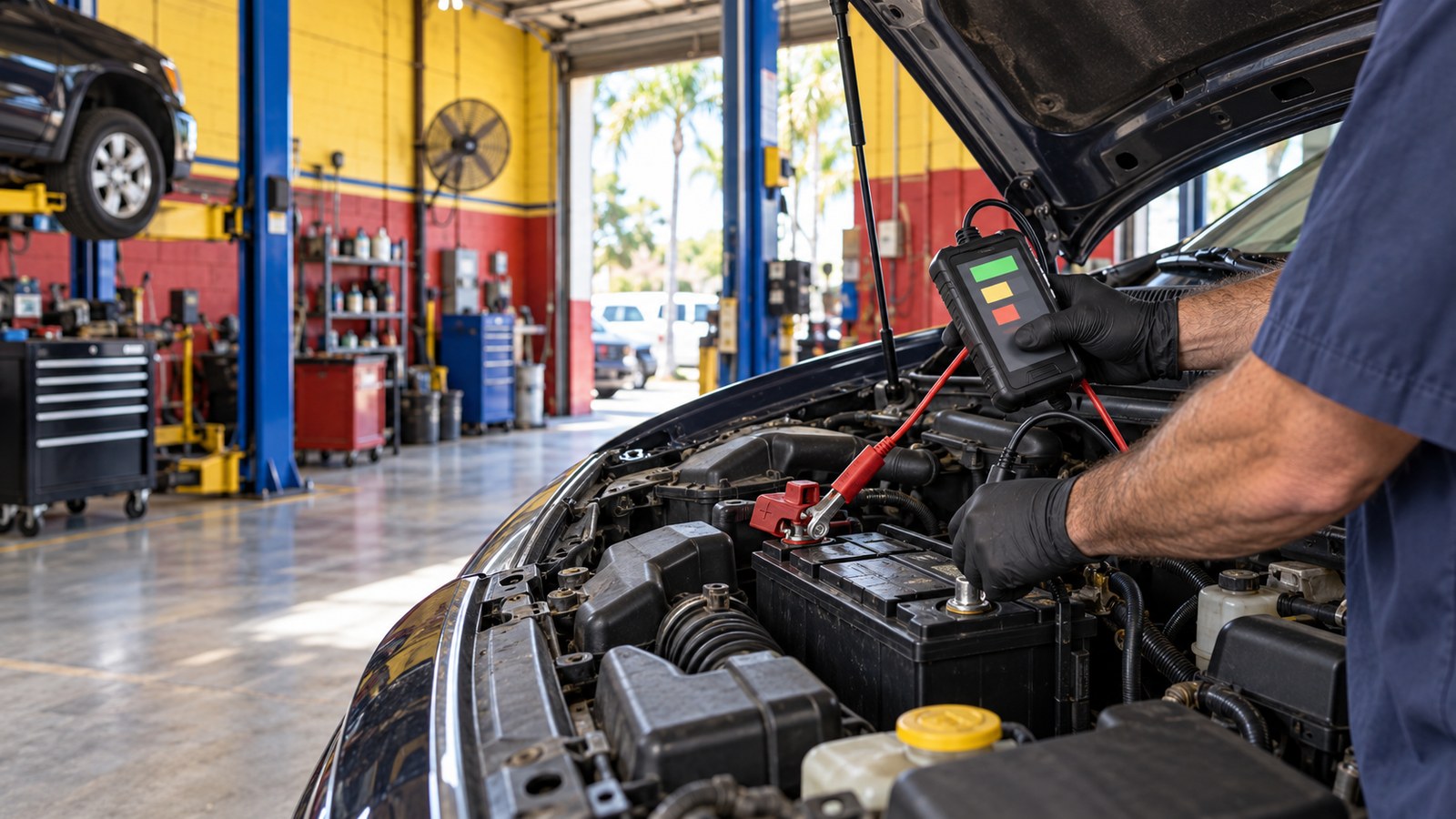
Batteries, starters and alternators are handled at Pelican Auto Care, 31465 US Highway 19 N, Palm Harbor, FL 34684, next door to the car wash.
More detail is on the battery, starter and alternator page. If the car is running but something else is not right, the check engine diagnostics page is the better starting point.
Frequently asked questions
Why do batteries fail in summer if they always die in winter?
Both are true, and they are two stages of the same story. Heat does the damage, accelerating the chemical reactions and the corrosion inside the battery. Cold reveals it, because a cold engine is harder to turn and a weakened battery finally cannot manage it.
How long should a battery last in Florida?
Less time than the same battery would manage in a cool climate. Sustained high under-hood temperatures shorten service life, so a Florida battery that is a few years old is worth testing instead of trusting, even if it has given no trouble.
Is a slow crank a reliable warning?
It is the most useful one, but it is not guaranteed. Modern batteries often fail with very little notice, going from apparently fine to unable to start the car in a short space of time. That is why testing beats waiting for symptoms.
If a jump start works, is the battery the problem?
Not necessarily. A jump proves the engine will run once it has turned over. It does not tell you whether the battery failed to hold charge, whether the alternator failed to replace it, or whether the starter is drawing more than it should.
Where does Pelican test batteries?
At Pelican Auto Care, 31465 US Highway 19 N in Palm Harbor. The battery, the starter and the alternator are tested together, because a no-start is one symptom with three possible causes.
Have it tested before it strands you
Pelican Auto Care, 31465 US Highway 19 N, Palm Harbor, next door to the car wash on US Highway 19.