
Guides
Florida window tint law, explained
The numbers people argue about in parking lots, taken straight from the Florida Statutes and attributed section by section.
Florida law, in one paragraph
How dark can car window tint legally be in Florida?
Florida sets a floor for how much light must get through and a ceiling on how mirrored the glass may look. The windows beside and in front of the driver must pass at least 28 percent of visible light and reflect no more than 25 percent (s. 316.2953). The windows behind the driver, including the rear window, must pass at least 15 percent, or 6 percent on a multipurpose passenger vehicle, and reflect no more than 35 percent (s. 316.2954). The windshield may not be tinted across the driver's view at all, though a transparent strip is allowed above the AS/1 line (s. 316.2952). Every one of those percentages carries a tolerance of plus or minus 3 percent (s. 316.2955).
Two numbers, not one
Almost every conversation about tint is really about one number, how much light gets through the glass. Florida law regulates two. The first is light transmittance, the share of visible light that passes through the window and the film together. The second is total solar reflectance of visible light, measured on the side of the glass away from the film, which is a limit on how mirrored the window may look from outside.
A film can be perfectly legal on darkness and still fail on reflectivity. That is the part people skip, and it is written into every one of the sections below.
The second thing worth knowing before the table: the law treats the windows beside the driver very differently from the windows behind the driver. The rules are stricter at the front, because that is the glass the driver looks through and the glass an officer looks into.
What the statute allows, window by window
Read across each row. The citation is the section of chapter 316 that the limit comes from, so you can check any line of this table against the law itself. Every percentage in the table carries a tolerance of plus or minus 3 percent under section 316.2955.
| Window | Light that must get through | Reflectivity limit | Statute |
|---|---|---|---|
| Windshield | No sunscreening material across the driver's forward view. A transparent strip is allowed at the top, above the AS/1 line. | Not applicable, the strip must be transparent. | s. 316.2952 |
| Front side windows, beside and ahead of the driver | At least 28 percent light transmittance. | Not more than 25 percent total solar reflectance of visible light. | s. 316.2953 |
| Side windows behind the driver | At least 15 percent light transmittance, or at least 6 percent on a multipurpose passenger vehicle. | Not more than 35 percent total solar reflectance of visible light. | s. 316.2954 |
| Rear window | At least 15 percent light transmittance, or at least 6 percent on a multipurpose passenger vehicle. | Not more than 35 percent total solar reflectance of visible light. | s. 316.2954 |
The windshield rule is the strictest one
Section 316.2952 does not set a darkness percentage for the windshield. It bans sunscreening material there outright, with a short list of exceptions. One of them is a strip at the top, and the statute says that strip must be transparent and must not encroach on the driver's direct forward viewing area, which it defines by reference to Federal Motor Vehicle Safety Standard No. 205 as the AS/1 portion of the windshield.
On most vehicles the manufacturer has marked that boundary for you. The letters AS1 are etched into the glass near the top edge, and the strip has to stay above them.
The same section separately permits a paper or certificate that the law requires you to display, an electronic toll payment device issued by a governmental entity, and a satellite navigation or driver safety monitoring device. Those are exceptions for specific objects, not a general permission to put things on the windshield.
Behind the driver, and the mirror requirement
Section 316.2954 covers everything behind the driver, and it is broader than film. It also addresses perforated materials, which must let through at least 30 percent and reflect no more than 35 percent, and it sets out how that is measured: the material is divided into sixteen equal sections, the readings are averaged, and no single section may read above 50 percent.
Louvered materials are allowed on the rear window so long as the driver's visibility is not reduced by more than half. Privacy drapes, curtains and blinds are allowed, but only where they are held open and secure while the vehicle is being operated.
There is a condition attached that catches people out. If the rear window is not transparent, the vehicle has to carry side mirrors on both sides that meet the requirements of section 316.294. A van with no rear view is legal with the right mirrors and not legal without them.
Medical exemptions and who else is excluded
Section 316.29545 provides for certificates of medical exemption. The department issues them, in consultation with the Medical Advisory Board described in section 322.125, to people with Lupus, any autoimmune disease, or another medical condition that requires limited exposure to light. The department may charge a fee for the certificate.
A certificate is not a general license to drive any tinted car. It is issued against one vehicle and records the make, model, year and vehicle identification number, along with the decal number and the names of the registered owners. The statute makes it nontransferable, and it becomes void when that vehicle is sold or transferred.
The same section excludes law enforcement vehicles used in undercover or canine operations, and it exempts certified process servers appointed under section 48.29 and private investigators and investigative agencies licensed under chapter 493 from sections 316.2953, 316.2954 and 316.2956.
The label on the door jamb, and the 3 percent
Two things in section 316.2955 rarely come up in the parking lot argument, and both of them matter more than the argument does.
The first is the label. The statute requires each installer or seller of sunscreening material to provide the purchaser with a pressure-sensitive, self-destructive, nonremovable, vinyl-type film label stating that the material complies with sections 316.2951 to 316.2954, and it requires the installer to affix that label to the inside left door jamb of the vehicle. The label also has to state the trade name of the material and the business name of the installer or seller. Factory glazing that already meets Federal Motor Vehicle Safety Standard No. 205 is exempt from the labeling requirement, which is why a car that left the factory with dark rear glass has nothing on the jamb.
The second is the tolerance. Every percentage measurement required by sections 316.2951 to 316.2954 is subject to a tolerance of plus or minus 3 percent. That is a measurement allowance, not a margin to aim into. A film sold as 28 percent that reads 26 on the meter is inside the tolerance; a film chosen because 25 sounds close enough is not.
The same section directs the department to approve the light transmittance measuring devices used to take those readings, and says a reading from an approved device is presumed accurate and admissible in the trial of an infraction. The meter at the roadside is the number that counts, not the number on the box the film came in.
What happens if the tint is over the line
Each of the three window sections says the same thing about consequences for the driver. A violation is a noncriminal traffic infraction, punishable as a nonmoving violation as provided in chapter 318. It is not a criminal matter and it does not carry points as a moving violation would.
The seller and the installer are treated differently. Section 316.2956 makes selling or installing sunscreening material in violation of any provision of sections 316.2951 to 316.2955 a misdemeanor of the second degree, punishable as provided in section 775.082 or section 775.083. The same section also states that replacing or repairing material that was legally installed is not itself a violation.
The practical cost is usually the second one: film that has to come off and be replaced. That is the argument for getting the question settled before the film goes on rather than after.
Where Pelican fits into this
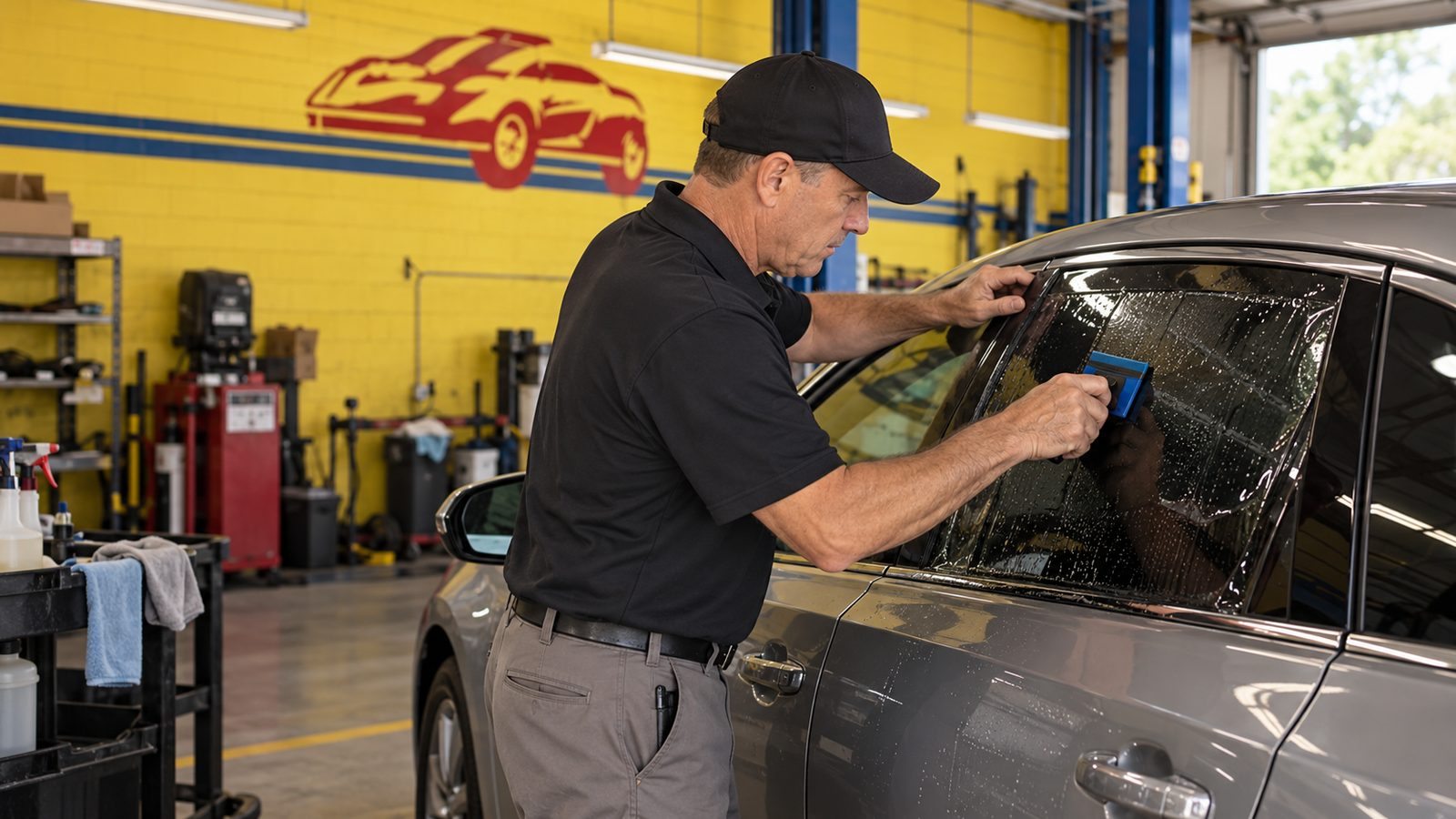
Automotive window tint is installed at 31425 US Highway 19 N, the same address as the car wash, the quick lube and the detail bay. What is right for your vehicle depends on the vehicle, on which windows you care about and on what you actually want from the film, so that conversation happens with a person who can see the car.
Call (727) 787-9274 and describe it, or read the window tinting page first. Tint work takes longer than a wash and the bay is not always free, so a call before you drive over saves a wasted trip.
Where these figures come from
Every number on this page was read from the Florida Statutes published by the Florida Senate, checked on 9 September 2026, in sections 316.2952 on windshields, 316.2953 on the windows beside and ahead of the driver, 316.2954 on the windows behind the driver, 316.29545 on exclusions and medical exemptions, 316.2955 on compliance labeling and tolerances, and 316.2956 on penalties.
This is a plain reading offered for general information, not legal advice, and the law can change. If your situation turns on the answer, check the current statute or ask the Florida Department of Highway Safety and Motor Vehicles directly.
Frequently asked questions
How dark can front side windows be in Florida?
Section 316.2953 requires sunscreening material on the windows beside and in front of the driver to have a light transmittance of at least 28 percent in the visible light range, and a total solar reflectance of visible light of not more than 25 percent measured on the side away from the film.
How dark can the windows behind the driver be?
Section 316.2954 sets a lower floor for those windows: at least 15 percent light transmittance, and at least 6 percent on a multipurpose passenger vehicle. Reflectance on those windows must not exceed 35 percent.
Can the windshield be tinted in Florida?
Not across the driver's view. Section 316.2952 allows sunscreening material along a strip at the top of the windshield so long as it is transparent and does not encroach on the AS/1 portion of the windshield as defined in Federal Motor Vehicle Safety Standard No. 205.
Is a tint sticker required in Florida?
Section 316.2955 requires each installer or seller of sunscreening material to give the purchaser a pressure-sensitive, self-destructive, nonremovable, vinyl-type film label stating that the material complies with sections 316.2951 to 316.2954, and requires the installer to affix it to the inside left door jamb. The label must also carry the trade name of the material and the installer's or seller's business name. Factory glazing that complies with Federal Motor Vehicle Safety Standard No. 205 does not need one.
How exact do the tint percentages have to be?
Section 316.2955 states that every percentage measurement required by sections 316.2951 to 316.2954 is subject to a tolerance of plus or minus 3 percent. That is a tolerance on the measurement, not permission to aim below the limit.
What is the penalty for illegal tint in Florida?
Sections 316.2952, 316.2953 and 316.2954 each make a violation a noncriminal traffic infraction, punishable as a nonmoving violation under chapter 318. Section 316.2956 adds that selling or installing sunscreening material in violation of sections 316.2951 to 316.2955 is a misdemeanor of the second degree.
Is there a medical exemption?
Yes. Section 316.29545 directs the department to issue certificates of medical exemption for people with Lupus, any autoimmune disease, or another medical condition requiring limited exposure to light, in consultation with the Medical Advisory Board. The certificate is tied to one specific vehicle and is void when that vehicle is sold or transferred.
Does Pelican check whether my tint is legal?
Talk to us about it directly. Call (727) 787-9274 and describe the vehicle and what you want from it. This page explains the law so you know what you are asking about, but the conversation about your particular car happens with a person, not a web page.
Ask about tint before you drive over
31425 US Highway 19 N, Palm Harbor. Monday to Saturday 8:00 am to 5:30 pm, Sunday 10:00 am to 4:00 pm.