
Guides
Salt air and your car in Pinellas County
Living between the Gulf and the bay costs vehicles something. Here is where it actually shows up, and what regular washing changes.
The short answer
Does salt air damage cars if you never drive on the beach?
Yes. Salt does not need the beach to reach a vehicle: onshore wind carries fine salt aerosol inland and it settles on everything, which is why coastal corrosion turns up on cars that have never been near sand. It starts where nobody looks, underneath and inside seams, edges and paint chips, not on the panels you can see. Washing slows the process and does not stop it, and no honest shop will tell you otherwise. What it does is remove the salt before it has had months to sit against metal, which makes how often you wash more important than how thorough any single wash is. Wax adds a sacrificial layer with a limited life, so it is something you renew and not something you buy once.
Salt gets to the car without the car going to the salt
Palm Harbor sits on a narrow strip with the Gulf on one side and Old Tampa Bay on the other. Wind off the water carries a fine salt aerosol inland, and it settles. That is the whole mechanism. A vehicle that has never been driven onto sand still collects it, from the air, every day it is parked outside.
What makes salt corrosive is not the salt on its own but salt plus moisture. Dissolved in a film of water it becomes an electrolyte, and that is what lets the electrochemical reaction we call rust proceed. Florida supplies the moisture free of charge: humidity, afternoon storms, and dew every morning on a car left out overnight.
It starts where you are not looking
Modern paint is good and body panels are usually galvanised, so the visible surfaces of a coastal car often look fine for years. The damage tends to begin somewhere else: on the underside, in the seams and pinch welds where water sits, around brake and fuel lines, at the tops of strut towers, in the wheel wells, and at any chip or scratch where the paint no longer covers metal.
Two other places worth knowing about. Electrical connectors and grounds corrode in coastal air, and the symptoms that produces look like anything but corrosion: an intermittent fault, a sensor reading that drifts, a light that comes on and goes away. And bright work, badges and trim will pit long before the paint next to them does.
The practical consequence is that judging a coastal vehicle by how the paint looks is judging it by the one part that was engineered to survive this. Somebody should look underneath from time to time.
What washing actually does
Washing does one thing, and it is worth being precise about it. It shortens the length of time salt spends in contact with the vehicle. Corrosion is a function of exposure, so a car washed regularly has had far fewer accumulated hours of salt sitting against it than an identical car washed twice a year, even if both look clean on the day.
That is why frequency matters more than intensity here. One very thorough wash in March does less for a coastal vehicle than a routine one every couple of weeks, which is the argument for an unlimited wash membership on this coast instead of paying per visit and going less often.
What washing does not do is stop rust. Nothing available at a car wash stops rust. Anyone who tells you otherwise is selling something, and the honest word for what regular washing buys you is time.
Wax, and why it is a renewable thing
A layer of wax sits between the paint and whatever lands on it. Salt, pollen, road film and bird droppings hit the wax first, which is the point: it is sacrificial, and it is much easier to replace than paint. It also makes the following wash more effective, because contaminants have less to bond to on a waxed surface.
Wax has a limited life, particularly under Florida sun, so it is maintenance, not a purchase. Pelican applies hand wax at 31425, and it is included in the exterior detailing work, which also clays the paint first so the wax goes onto a genuinely clean surface rather than over the top of what was already stuck there.
What Pelican can do about it
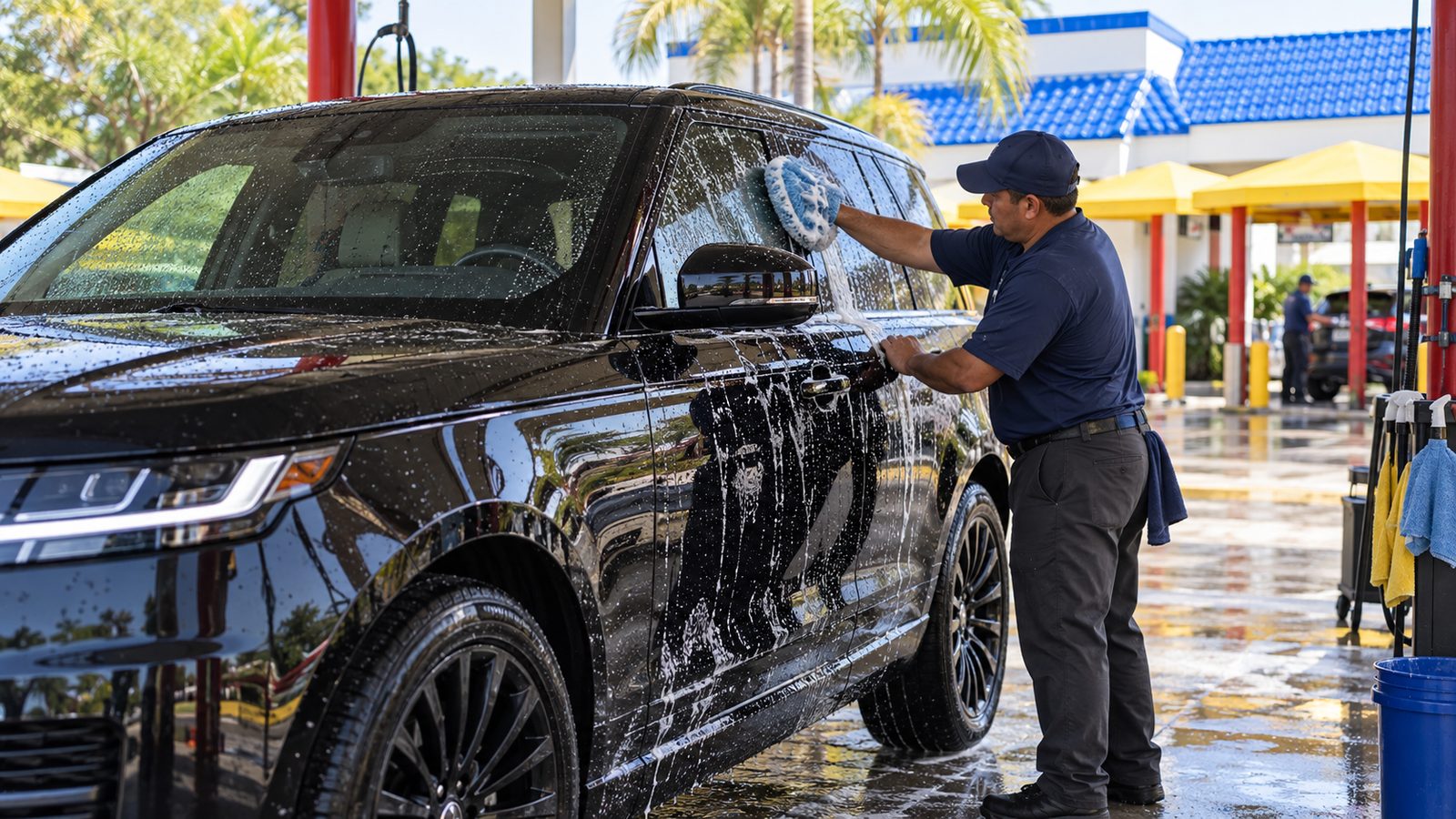
At 31425 US Highway 19 N: car washing, hand washing for large and high-end vehicles, interior and exterior detailing, hand wax and oil changes. That covers the routine that keeps salt from accumulating, and the periodic work that puts protection back on the paint.
What is happening underneath is a mechanical question, not a cleaning one. That side is Pelican Auto Care at 31465, next door, where a vehicle goes on a ramp and somebody can actually look at the brake lines, the seams and the fixings that coastal air reaches first.
Frequently asked questions
Do I really get salt damage if I never drive on the beach?
Salt does not need the beach to reach a vehicle. Onshore wind carries fine salt aerosol inland and it settles on everything, which is why coastal corrosion shows up on cars that have never been near sand.
How often should a car be washed on the coast?
More often than inland, and the reason is exposure time, not appearance. Salt that sits on a surface keeps working on it, so the interval matters more than the thoroughness of any single wash.
Does washing stop rust?
It slows the process. It does not stop it, and no honest shop will tell you otherwise. What washing does is remove the salt before it has had months to sit against metal, paint chips and seams.
Is wax worth it in a coastal climate?
Wax puts a sacrificial layer between the paint and what lands on it, and it makes the next wash more effective because contaminants have less to grip. It is protection with a limited life, so it is something you renew, not something you buy once.
What about the parts I cannot see?
That is where coastal corrosion usually starts, so have somebody look underneath periodically instead of judging the car by its paint. Mechanical inspection is next door at Pelican Auto Care, 31465.
Keep the salt off it
31425 US Highway 19 N, Palm Harbor. Monday to Saturday 8:00 am to 5:30 pm, Sunday 10:00 am to 4:00 pm.