
Guides, 31425
How often to wax and detail a car in Florida
Every published interval for wax assumes a gentler climate than this one. Here the honest answer is to read the paint rather than the calendar.
The short answer
How often should you wax a car in Florida?
Read the paint instead of the calendar, because every published interval assumes a gentler climate than this one. Ultraviolet exposure and heat break a wax layer down, a car parked outside here gets far more of both than the same car would further north, and salt aerosol on this coast adds to it. The test is what water does: on protected paint it pulls into tight beads and runs off carrying dirt with it, and as the protection goes the beads flatten into sheets that sit on the surface. The paint will also start to feel slightly rough to a fingertip instead of slick, and it will stop looking clean as quickly after a wash. Waxing is not a thorough wash, either. Washing removes what landed on the paint; wax is a sacrificial layer placed between the paint and whatever lands on it next.
Cleaning and protecting are two different jobs
A wash removes what has landed on the paint. A wax puts something between the paint and whatever lands on it next. They are related but they are not the same activity, and washing a car every week does nothing whatsoever to protect it if there is no protection left on the surface.
The reason protection matters is that a wax layer is sacrificial. Salt, pollen, road film, bird droppings and ultraviolet light all attack the wax first, and wax is very much cheaper to replace than paint is.
Why Florida shortens every published interval
Wax degrades under ultraviolet light and under heat, and this state supplies an unusual amount of both. A vehicle parked outside here spends the year under stronger sun for more hours than the same vehicle would almost anywhere further north, and the surface temperature a dark hood reaches on a July afternoon is not comparable to a temperate summer.
The coast adds a second mechanism. Salt aerosol carried inland from the Gulf and the bay settles on paint continuously, and afternoon storms and overnight dew supply the moisture that makes it aggressive. The protective layer is working every day, not only when the car is driven.
Frequent washing helps here, it does not hurt, because it removes the contaminants before they have weeks to work on the layer. What frequent washing cannot do is replace the layer once it is gone.
How to read the paint instead of the calendar
Water behavior is the most reliable test and it costs nothing. On protected paint, water pulls itself into tight rounded beads that roll off and carry dirt with them. As protection fails, those beads flatten and eventually spread into flat sheets that sit on the surface and dry where they are.
Touch is the second test. Run a fingertip lightly over a horizontal panel after washing. Protected paint feels slick. Paint that has lost its layer feels very slightly gritty, which is contamination bonded directly to the clear coat instead of to a sacrificial layer above it.
The third signal is how long clean lasts. A car that looks dusty two days after a wash has nothing on the surface for dust to fail to stick to. Horizontal surfaces go first, so the hood, the roof and the trunk lid tell you before the doors do.
Where detailing is different from a wash package
The upper wash tiers at 31425 include a polish wax and a sealer wax applied as part of the wash. That is real protection and for many vehicles it is the right level of it, applied often, as part of a routine.
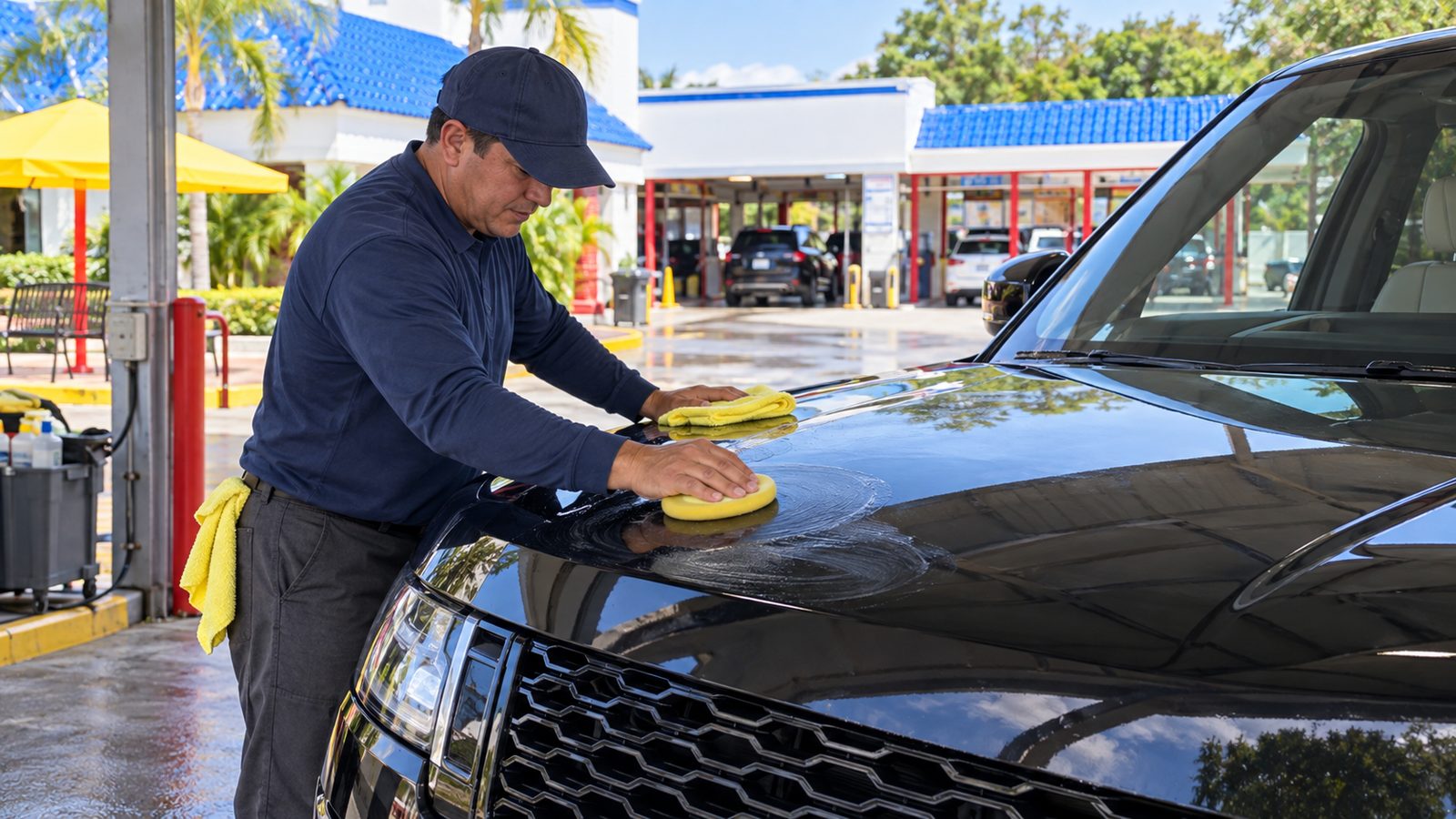
Detailing is a different job with a different amount of time in it. The exterior detail decontaminates the paint first, usually with a clay treatment that lifts bonded contamination the wash process leaves behind, so what goes on afterwards goes onto genuinely clean paint. That distinction is the whole reason the two are priced differently.
At Pelican the exterior detail starts at $149, the interior detail starts at $189, and the Ultimate Detail, which is both together, starts at $250. All three are set out on the detailing packages page.
The interior has its own Florida problem
Sun does to an interior what it does to paint. Dashboards, door cards and any leather or vinyl dry out and fade under prolonged ultraviolet exposure, and once a dash has cracked it does not come back.
Humidity is the other half. Carpets and upholstery hold moisture, and moisture plus the organic material that arrives on shoes and in food produces a musty smell that is far easier to prevent than to remove. Once or twice a year suits most vehicles, more with children, pets or regular trips to the beach. What is included is on the interior detailing page.
Putting it together
For a car kept outside on this coast, the routine that actually works is washing often enough that salt never sits for long, and restoring the protective layer whenever the water stops beading, not whenever a date arrives.
Hand wax and detailing are both at 31425 US Highway 19 N, Palm Harbor. Related reading: salt air and your car explains what the protection is protecting against, and hand wash or automatic covers the washing half of the routine.
Frequently asked questions
How do I know when the wax has gone?
Watch what water does. On protected paint, water pulls into tight beads and runs off, taking dirt with it. As the protection wears, the beads flatten and spread into sheets that sit on the surface. The paint will also start to feel slightly rough to a fingertip instead of slick, and it will stop looking clean as quickly after a wash.
Is waxing different from washing?
Completely. Washing removes what has landed on the paint. Waxing puts a sacrificial layer between the paint and whatever lands on it next. One is cleaning and the other is protection, and doing the first frequently does nothing at all about the second.
Does wax last less time in Florida?
Yes, and by a meaningful margin. Ultraviolet exposure and heat both break down a wax layer, and a car parked outside here gets far more of both than the same car would in a temperate climate. Salt aerosol on this coast adds to it. Any general figure for how long a wax lasts assumes gentler conditions than these.
What is the difference between detailing and a top wash package?
Depth and time. The top wash tiers include a polish wax and a sealer wax applied as part of a wash process. Detailing is a separate job in which the paint is decontaminated first, usually with a clay treatment, so the protection goes onto genuinely clean paint instead of over the top of what was still bonded to it.
How often should the interior be detailed?
Once or twice a year for most vehicles, and more if the car carries children, pets, sand or food regularly. In this climate the specific reason to keep on top of it is that humidity plus organic material in carpets and vents is what produces a musty smell, and that is much easier to prevent than to remove.
Wax and detailing at 31425
31425 US Highway 19 N, Palm Harbor. Monday to Saturday 8:00 am to 5:30 pm, Sunday 10:00 am to 4:00 pm.